Telescope state integration
The MeerKAT telescope stores information about each observation using the katsdptelstate package. Information about the models used in an observation (and where to retrieve them) is stored in the telescope state so that they may be retrieved later.
The telescope state contains an sdp_model_base_url attribute which holds
a base URL for the models. All other URLs in the telescope state are relative
to this. For each model used there are two entries in the telescope state. One
has the suffix fixed and references the exact model that was current
at the time of the observation. This allows any analysis that was done at the
time to be reproduced. The second has the suffix config and references an
alias for the configuration. If an improved model is computed for this
configuration and uploaded to the model store, using this alias will
automatically reference this updated model. This allows analysis to use the
best current model when it is not necessary to match any online use of the
model done when the observation was made.
Because the MeerKAT Science Data Processor (SDP) allows multiple streams of
each type to be grouped into a single telescope state, some keys for
specifying models are scoped by the name of the
antenna-channelised-voltage input stream to which they apply. This is
represented as acv in the names below.
Example
We’ll use primary beam models for our example because it’s a complex case that
demonstrates multiple aspects of
the design. Consider a primary beam model for the UHF receiver on antenna
m012. For the sake of this example, we’ll use the receiver serial number and a
year as the configuration name. Then the initial setup as aliases
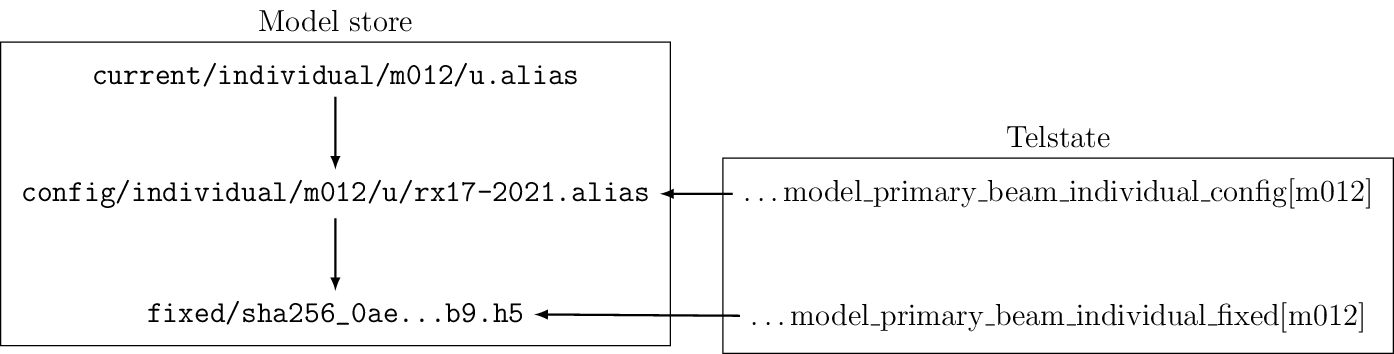
may be as seen in the left side of the figure below. After an observation has
been run, the telescope state (as serialized to the .rdb file) appears on
the right, where the brackets indicate that this is an element of an indexed
key (individual indicates that this is a model suitable for consumers that
prefer per-antenna models over array-average models).
Now suppose further holography allowed the model for this configuration to be improved, and a new model was uploaded. This would lead to the following situation:
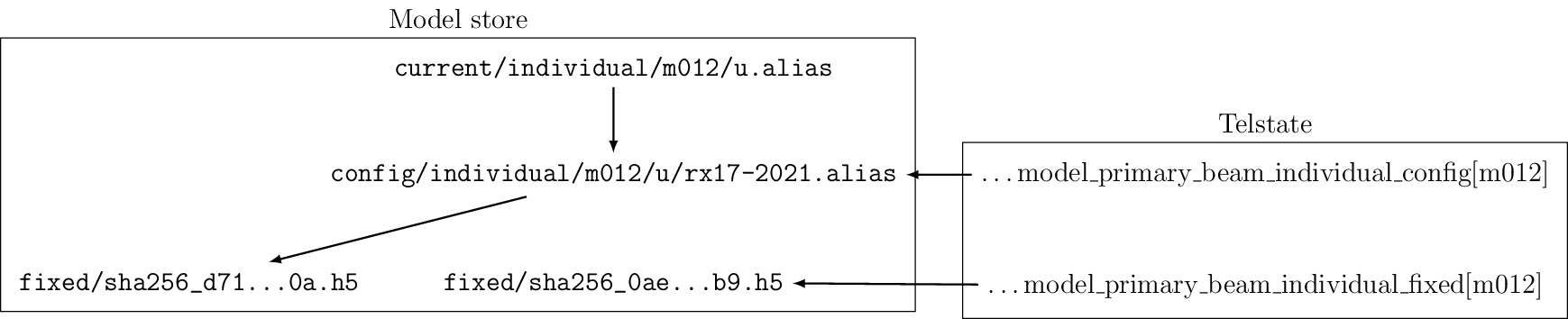
The telescope state has not been altered, but by using the
model_primary_beam_individual_config key, one can access the improved
model, without losing track of the model that was used online.
Next, suppose the receiver on m012 was swapped out for a different one. Then the situation might change to look like this:

The existing .rdb file continues to reference the old configuration,
but if a new observation were started now, it would follow the alias chain
down the left side to reference the new configuration and model.
Model keys by type
Each of these keys contains a relative URL, as described above. The
type is either fixed or config.
- RFI mask
model_rfi_mask_type- Band mask
acv_model_band_mask_type- Primary beam
acv_model_primary_beam_group_type, wheregroupis one ofindividualorcohort. This is an indexed telescope state key, with the antenna name as the index.
API
In future katdal may be updated to hide these details and allow models to
be fetched directly from a katdal data set. Until then, one can obtain the
underlying telescope state object from a dataset as
dataset.source.telstate. Pass it to the constructor of
katsdpmodels.fetch.aiohttp.TelescopeStateFetcher (asynchronous) or
katsdpmodels.fetch.requests.TelescopeStateFetcher (synchronous), along
with an (optional) underlying fetcher. Then use
get() to retrieve
models. Instead of passing an URL (as for the underlying fetcher classes),
pass the name of the telescope state key holding the relative URL.
In some cases one may wish to look up the key within a telescope state view.
This can be done by passing the view as a telstate keyword argument. Here
is an example of fetching a band mask model from a view called
telstate_cbf which refers to the antenna-channelised-voltage stream:
with katsdpmodels.fetch.aiohttp.TelescopeStateFetcher(telstate) as fetcher:
    band_mask_model_key = telstate_cbf.join('model', 'band_mask', 'fixed')
    try:
        band_mask_model = await fetcher.get(band_mask_model_key,
                                            katsdpmodels.band_mask.BandMask,
                                            telstate=telstate_cbf)
        return band_mask_model
    except (aiohttp.ClientError, katsdpmodels.models.ModelError) as exc:
        logger.warning('Failed to load band_mask model: %s', exc)
        return None